China’s Multi-Channel Mercury Slip Rings Break 40-Year Foreign Monopoly
Liquid Metal Conductivity: Redefining Rotary Connections
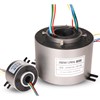
A mercury slip ring is a rotary connector that uses mercury as a fluid conductive medium. Its operating principle differs fundamentally from traditional carbon-brush slip rings. Conventional slip rings transmit signals and current through sliding friction between conductive rings and brushes. Mercury slip rings, by contrast, fill the gap between the stator and rotor with liquid mercury, enabling 360-degree frictionless conduction through liquid metal. This design eliminates mechanical wear at the source and reduces contact resistance to extremely low levels—some products maintain contact impedance at around 0.15 μΩ, far better than the 5–20 μΩ fluctuation typical of solid-contact solutions.
Thanks to the self-lubricating properties of liquid metal and its self-repairing contact mechanism, mercury slip rings can offer fatigue life 10 to 50 times longer than ordinary slip rings. Their torque is also about one-third lower than that of traditional slip rings, and they support stable operation at speeds above 3,000 rpm.
Domestic Breakthrough: Ending a 40-Year Market Monopoly
For decades, high-end mercury slip ring technology was monopolized by a small number of overseas companies. In recent years, Chinese firms such as Wuhan Weiming Machinery have begun to change that. The company was founded by engineer Kong Lizheng, an early pioneer in the domestic production of mercury slip rings and gallium-alloy slip rings, with 13 years of industry experience. In 2025, the company reportedly achieved a breakthrough in multi-channel series technology, using liquid mercury connections to enable multi-channel conduction. This broke a foreign market monopoly that had lasted for 40 years and provided an alternative for domestic high-end equipment.
In terms of research and development, Chinese companies have also developed anti-fog mercury slip rings, fully sealed anti-corrosion mercury slip rings, and ultra-high-speed fluid slip rings for different operating environments. These products have gained the trust of many large domestic and international enterprises.
Applications Expand Across High-End Sectors
Mercury slip rings are rapidly expanding from traditional industrial applications into high-end fields. In medical imaging equipment, the rotating scanning components of CT scanners and MRI machines need to transmit high-definition image signals in real time. Mercury slip rings help ensure zero distortion. In intravascular ultrasound imaging systems, the wide bandwidth of mercury slip rings allows the system to operate simultaneously at 40 MHz and 60 MHz, providing clearer images for clinical diagnosis.
Military radar systems also benefit from mercury slip ring technology. On high-speed rotating antennas, mercury slip rings can stably transmit control commands and detection signals, helping ensure radar detection accuracy and response speed. Mercury slip rings are also widely used in semiconductor manufacturing equipment, electroplating equipment, robotics, wind power generation, and satellite communications.
Broad Market Prospects
According to market research firm WiseGuy Reports, the global mercury slip ring market was valued at approximately US$799.2 million in 2024 and is projected to grow to US$1.5 billion by 2035, with a compound annual growth rate of about 5.9%. The liquid-metal slip ring segment is also expected to maintain steady growth, with the global market projected to reach US$28.68 million in 2026.
In terms of the competitive landscape, major global players in the mercury slip ring market include Schleifring GmbH, Conductix-Wampfler, JINPAT Electronics, Moflon Technology, and MERSEN. As Chinese companies continue to make breakthroughs in multi-channel technology, sealing processes, and environmental resistance, the global market share of domestic mercury slip rings is expected to rise further.
Environmental Challenges and Technological Evolution
It is worth noting that while liquid mercury delivers excellent conductive performance, it also raises environmental concerns. The industry is actively exploring alternatives. Some companies have already introduced upgraded replacement series that retain the superior performance of traditional mercury slip rings while eliminating the environmental risks associated with mercury. Gallium-alloy slip rings, another liquid-metal conductive solution, are also being developed and promoted at a faster pace.
Industry analysts believe that as demand for reliable rotary connections continues to rise in high-end manufacturing, medical imaging, aerospace, and new energy, mercury slip rings and their next-generation alternatives will enjoy broader development space. Continued innovation by Chinese companies in this sector is reshaping the competitive landscape of the global mercury slip ring industry.